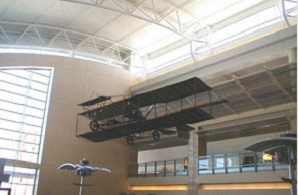
The Pliska Aeroplane
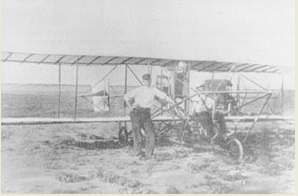
The Pliska Aeroplane was built in 1911 in Midland, Texas by John V. Pliska, a blacksmith, and Gray Coggin, a chauffeur and auto mechanic. It was the first aeroplane built and flown in the State of Texas.
The Pliska Family
The Pliska family immigrated to the United States from Teene, Austria in 1897 and settled in Central Texas in a small farming community near LaGrange. Pliska found work as a blacksmith; however, in 1903, he set out for Mexico City to find his fortune. The train stopped in Midland, and Pliska helped a local blacksmith who in turn offered him a job. He accepted and began his new home in Midland.
In 1905, Pliska became the first person in Midland County to become a naturalized citizen of the United States. In 1909, he opened his own blacksmith shop.
The Inspiration
On November 19, 1911, Robert G. Fowler landed his Wright Flyer II in Midland. Pliska had been fascinated with aeroplanes, and Fowler's visit rekindled his dream of building one. He discussed his plan with Gray Coggin, a local auto mechanic, and together they took photographs and studied Fowler's plane and made plans to create their own aeroplane.
The Construction
The Pliska Aerocraft was literally built with their bare hands and only the simplest machinery Pliska had in his blacksmith shop. The aerocraft was made from wood, piano wire, and canvas that was not shellacked. Later they discovered that shellacking the canvas increased the lift by preventing airflow through the canvas, thus causing more airflow over the wings.
The propeller, made of wood, was getting chewed up by rocks and debris. This resulted in using a tin covering that was actually sewn over the wood blades with wire to prevent further prop damage.
Aeroplane Specifications
| Specification | Measurement |
|---|---|
| Wing Span | 33 feet |
| Height | 7.5 feet |
| Length | 26.5 feet |
| Empty Weight | 750 pounds |
| Gross Weight (with pilot and fuel) | 1,050 pounds |
| Power Plant | Roberts Motor Company, Sandusky, Ohio |
The 50 horsepower, No. 106 motor was actually built before 1910. It is a 4-cylinder, 2-cycle motor which used a mixture of three pints of oil to every five gallons of gasoline.
Test Flights
As test flights were made, usually about one-fourth mile in length, the craft was modified and often repaired. Later flights extended to one to two miles in length as the design improved.
Donation to the City
When the blacksmith shop was torn down in 1962, the plane was given to the City of Midland by the children of John V. and Louise Hundle Pliska. The aeroplane restoration, as well as the original museum, was funded by the Abell-Hanger Foundation and was completed on October 19, 1965.
However, due to airport expansions during the past few years, airport patrons were unable to view the Pliska Aeroplane as the museum area became inaccessible.
A New Home
Thanks to the restoration work of a group of dedicated members of the West Texas Aerobatics Club, the Abell-Hanger Foundation, and the City of Midland, the Pliska Aeroplane now has a new home.
The restored aeroplane hangs suspended above the baggage claim area in the Midland International Air & Space Port Terminal Building. The historic aeroplane can now be enjoyed by all airport patrons, visitors, and employees. It is an important part of aviation and Texas history.