
Midland Army Air Field
During World War II, Midland's small civilian airfield transformed into one of the nation's premier military training facilities, producing over 8,000 bombardiers who served in the war effort.
Sloan Field
Midland International Air & Space Port was originally Sloan Field, a small airport started in 1927 by Samuel Addison Sloan. Sloan leased 220 acres of flat grassland from Clarence Scharbauer, a rancher. Sam Sloan was killed in 1929, and his brother, William Harvey Sloan, continued the operation. In 1939, Harvey Sloan sold the field to the City of Midland for $14,500.
The Push for an Air School
Prominent businessmen in Midland could foresee the possibility of a military base in West Texas. In 1940, after Hitler struck Poland, they started promoting the airport for use as a training base to the military establishment in Washington. Work was done by the WPA with runway and taxiway improvements, as well as airfield lighting.
A visit by Brigadier General G.C. Brant, Commander of the Gulf Coast Air Corps Training Center at Randolph Field, confirmed that the situation at Midland was very favorable. On Friday, June 13, 1941, it was announced that Midland would get the air school.
Target Ranges
Immediate search for ranch land to be used as target ranges was instigated and plans for "an advanced twin-engine flying and bombardment school" had begun. Ground was broken on July 15, 1941, with the leasing of 1,030 acres of land for the duration of the war plus six months. Twenty-three bomb ranges were mapped out, located within a 50-mile radius of the base.
Construction
One of the first structures to go up was the 500,000-gallon water tank, which remains in use today. Buildings for Headquarters, officer, enlisted, and cadet barracks, a station hospital, classrooms, mess hall, and flight line were all erected by civilian employees.
By the time the first enlisted man arrived in October 1941, he found that 105 buildings were partially completed with the remaining 99 waiting to be started. In November 1941, officers and enlisted men started arriving for duty. It was announced that training of cadets would begin in January 1942.
The Need for Bombardiers
With the bombing of Pearl Harbor on December 7, 1941, the need for bombardiers was evident. Soon after, an announcement was made by Lieutenant Colonel Isaiah Davies, Commanding Officer of Midland Army Air Field (MAAF), that the school would be used exclusively to train bombardiers.
The Bombardier College
The sole purpose of the Bombardier College was to train young men to use the Norden bombsight, invented by Carl Norden. Cadets remained at Midland for exactly 12 weeks of combined ground and flight training, rigorous physical activity, and rigid military discipline during a 16-hour day, with only part of Sunday off.
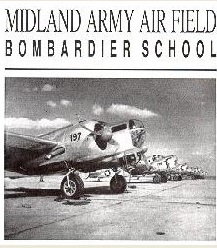
They learned to hit targets with remarkable accuracy, dropping at least 200 practice bombs each from the AT-11 airplane, and learned to handle the complex Norden sight with considerable skill.
The first class consisted of 103 cadets and graduated on April 30, 1942. The last class graduated in January 1946. Students from the Netherlands, East Indies, France, Brazil, and China were trained alongside American cadets at MAAF. In total, over 8,000 bombardiers were trained at this base from 1942 to 1946.
Training the "Bombardiers"
The bombardiers trained at Midland played a critical role in the war effort. Using the top-secret Norden bombsight, they were capable of precision bombing from high altitudes — a skill that required intense focus and extensive practice.
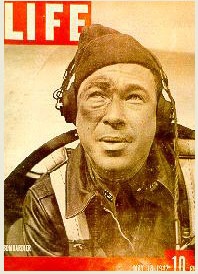
The rigorous training program and the skill of its graduates earned Midland Army Air Field national recognition. The importance of bombardiers to the war effort was reflected in popular media of the time, including features in LIFE magazine.
War's End
With V-E Day on May 8, 1945, and the surrender of Japan on August 15, 1945, the war concluded with the signing of the peace treaty on September 1, 1945, aboard the battleship Missouri. The base transitioned back to civilian use, eventually becoming the commercial airport that serves the Permian Basin today.